
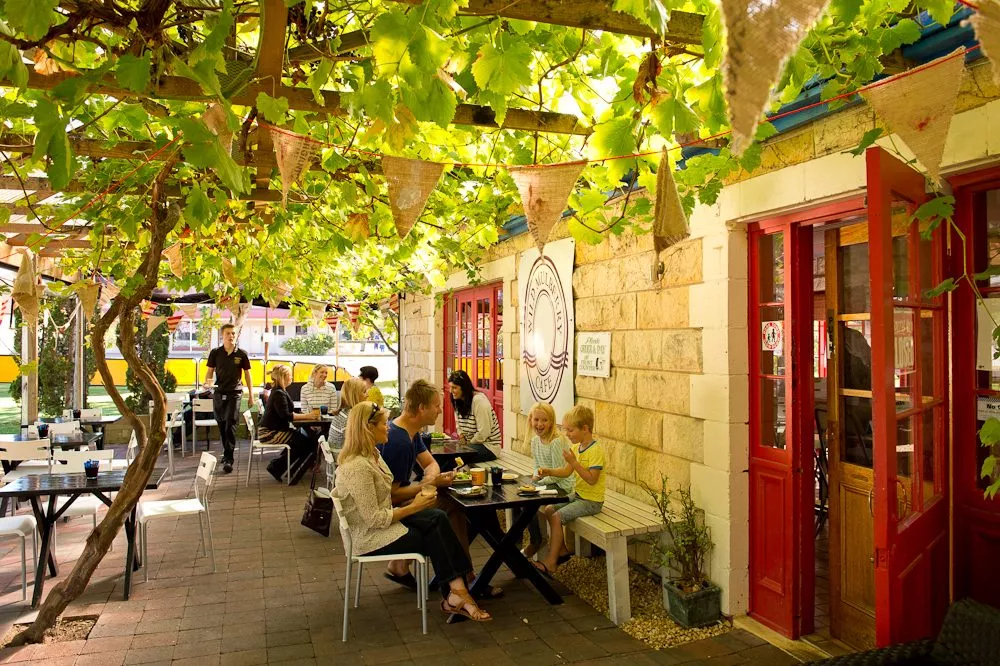
Every morning, unless the westerlies are coming in wild, I walk the path around the boat harbour in the small Australian coastal town where I live. The path moves through native salt-tolerant trees and shrubs which grow down to the water’s edge. The first section of it is surfaced; then, without fanfare, it mounts a board-walk, built, in an unexpected act of grace, by the local council of a decade ago. Then you walk through the upper branches of the trees themselves, and the birds flash by, streaks of colour and sound.
Further out, past the rocking boats, and through the entrance, is the Bay, and beyond the reefs that fringe it, the southern ocean, open all the way to Antarctica. You wonder each day how this has become the place where you have been allowed to live.
Not long ago, a handful of generations, this was First Nations country, the country of the Bunganditj people alone; and that is a founding story in its own right. On one side it is to be celebrated, for the richness of the oldest living culture on earth, old and deep beyond the imaginings of non-Aboriginal Australians; and on the other, the sombre history of colonisation and dispossession, which still continues. So we begin, as First Nations people have asked of us, by acknowledging that this lovely place where we live, and work, and write, and care is, and has always been, the country of the Bunganditj people, who are its traditional owners and custodians; we pay our deep respect to them, and to their elders, past, present, and emerging; and we accept the obligation for recognition and justice which flows from that acknowledgement and which must be met, without delay.
~~~
As I walk with those old voices, on most days there are others on the path. There are the runners, of different ages and fitness; some obviously athletes, on a mission; others more ordinary, earnest in exercise. Some are young parents, pushing their children in designer vehicles (one can’t very well call them prams) with easy energy, talking together as they pass. Others, like me, more advanced in age (to put it in a kindly way) walk carefully, placing their feet; which has, however, the advantage of allowing time to look around.
Most people, if you stop and talk to them, love the walk. One day not long ago an older man, balanced precariously on two walking sticks, came towards me; an uncle of a friend of mine, indomitable. As he moved closer, he waved one of his sticks to me and called, “Peace and silence reigns! Peace and silence reigns!” So it did; so it does, often.
As with the seasons of trees and winds and storms, so there are seasons of people on the walk. In winter most are people who live here. Many of them I know, and we stop and talk, pleased to be connecting with the life lines that we follow, individually and together. The population of people who would, if asked, call themselves local, who live in this place and have taken some kind of root here, consists of about 1500 people, so the latest census tells us; and for most of the winter the walk, and the town, is theirs.
In summer, though, a tide of visitors pours in, up to 20,000 at the height of the season. The walk becomes a river of faces I don’t know. They overflow the streets, and cram into the cafes. On the walk they tend to be the runners, working off city energy and focus, perhaps finding it difficult to believe that, for a little while, at least, there is time to walk, even to stop, and watch, and listen.
There are people from regional towns in the neighbouring state, or from other states. There is a steady flow of internationals, from Asia and Europe, and some, though fewer, from North America. From time to time 4-wheel drive caravans or motorcycle clubs descend on the town. Some come back every year.
And they are not all visitors, in the outsider sense. Many own houses in and around the town, which they occupy during the holidays and rent out through Airbnb or another online platform for the rest of the year. In retirement they move in and become part of the local population, whose fringes they may have occupied, on and off, in the regular rhythm of work in the city and holidays on the coast, for years.
On the walk, though, we are all together, wherever we came from and whatever has brought us here, in the weather the changeable ocean happens to give us, on this day, with the trees, and the birds, and the air as clean as any on the planet, and the water swirling under our feet, and the Bay and ocean stretching out before us.
~~~
Or so we like to think. Even here, in this place, it’s not so simple. More often, these days, walkers pass me with devices in hand, talking to them, looking at the screens, fingers active, or with headphones fixed, and the preoccupied look that speaks of attention somewhere else, somewhere other than here. The place has become unimportant, almost immaterial; daily exercise has to be done, and if it can be combined with social media or work connections, then why not? Isn’t that also a community activity?
And there are some who rarely appear on the walk at all. The young — younger than parents but older than those still at school — are unlikely to make an entrance. It’s not easy to see them at all: they don’t sit in the cafes, or walk much in the streets; some of them turn up on one of the surfing back beaches; but for much of the time they are almost invisible, moving, apparently, among the cheaper housing fringes, or in run-down cottages in the country, out of town.
At the other end of the spectrum are the old. Many of them are on their own; more of these are women, since they tend to outlive their male partners. There are single old men too, and not always well. There are some community structures for them: the community bus which takes them shopping; Meals on Wheels; Probus, or the University of the Third Age (an aspirational euphemism). But they are largely disenfranchised, like the young. Their opinions are not often sought, or listened to. They are expected, in the main, to get on with living out their lives. Unless they have the eccentric determination of my friend’s uncle, they don’t make much of an appearance, or a mark — certainly not on the walk.
There are younger families in trade, holding the place together as plumbers or electricians or mechanics or café owners. Or you could separate out, as indeed they often are, the newcomers of the last decade from the families who have been here across generations and think of themselves as the town’s owners — setting aside in turn the ancient claims of First Nations people. In nearby district towns there are groups of refugees and immigrants, from Asia, and Africa, and the Middle East.
~~~
So as I walk each morning, or sit on the cliffs overlooking the Bay, I find myself thinking about the people with whom I share this place. The collective noun that describes them, more often than not, is ‘the community’. The casual confidence with which that word is used seems to me to be remarkable; as though, of course everybody knows what it means and to whom it refers and what it brings to mind – just as one might speak of the weather, or the shops, or the beach. In my experience, nothing could be further from the truth. There are almost as many versions of community as there are people you ask.
For example, in the previous paragraph I have, without thinking, employed one of the long-held assumptions about community: ‘the people with whom I share this place.’ We tend to think a community as physically, geographically located; in the city, it’s a neighbourhood; in the country, a town or settlement. We speak of the local community — nothing could be more obvious. Can a group of people even claim to be a community if they are not in the same place?
Not long ago such a question wouldn’t have made sense. Today we would say, of course they can, and they do. Online communities of every scale and kind are distributed across the world. Has it replaced the old way of thinking about community, or does it sit alongside? Is it a more extended idea of community, or has it in some way contracted? Is it now a hybrid term; or is it transitional, perhaps, on the way out altogether?
~~~
The great twentieth-century philosopher Ludwig Wittgenstein — the last of that kind, some would say — proposed that ‘meaning is use’. His supporting examples were drawn from ordinary speech, such as is used, he thought, by bricklayers on a site.1 So how we use the word ‘community’ in ordinary settings may be one way to understand it better.
It certainly turns up in many settings. In the media, for example: ‘the community is against it’, ‘the community needs to step up’, ‘the community came together’, and so on. It threads documents of government, legislation, regulation, and guidance. Local government, for example, routinely recommends, even requires, ‘community engagement’, ‘community consultation’. The one thing that is common to all these contexts is the assumption that everyone knows what community means.
Yet if on closer inspection we are found to be using the term in different ways, even radically different ways, then that confusion matters to peoples’ lives. The word is used, but because of its vagueness and ambiguity it can’t be carried through with certainty to clear, agreed, practical actions. It becomes a placeholder, an enabler for something else, or it simply ticks a particular regulatory box — after a fashion. This retreat from shared meaning and action has real-world consequences for real people and their families. It matters. How can we live and work together if we’re not sure who we are and what we’re talking about?
~~~
Beyond that is the question, in turn, of whether the local, with its people, is still relevant to the global challenges of our times. Yet we are told that overwhelmingly the challenges we face are global in scale. Economic inequality across nations; the sixth wave of extinction; permanent losses of biodiversity; climate heating; nothing more global than these. And, as if we needed reminding, the COVID pandemic, which drove home our global identity in an uncompromising and tragic way. So, it might be asked, in the face of these global hurricanes, why are we thinking about community?
Against that is the simpler view is that community matters because communities have always been there, across space and time, in all countries and places, throughout history and prehistory; even through deep time; as, incomparably, for Australia’s own First Nations peoples, across more than 60,000 years.2
Communities have been the main form of social organisation until literally the last few decades, when urban life has surged. A century ago, about 10 percent of the world’s population lived in cities; now the figure is 50 percent, and accelerating. But even there, as Jane Jacobs and Mitchell Duneier have showed us, people who live in American cities have spontaneously identified with neighborhoods and with the communities that go with them. They have been at the centre of city life, the anchors around which the daily tides of people swing and surge.3
Wendell Berry, a self-styled agrarian, has been documenting and advocating for American rural communities for more than six decades.4 The idea of community remains the most common and the most natural way to speak of living together in Australia’s cities and country.5
~~~
So if ever there was a time to examine the roots of community, it is now. The questions are urgent, even critical, and multiple. What is the idea of community, and for whom? What sits at its heart? How is it to be preserved — if that is a goal we still want? How does it adapt to change? How is its resilience built and its capabilities best shaped? Does anything valuable of the past ideas of community remain to be taken forward? Has the idea of community been irrevocably changed by the online life in which we are all implicated? Most importantly, who is going to answer these questions, and with what authority?
There is no reason why we shouldn’t think this through, for ourselves. We can draw on what others have thought and written, if we find it useful; they can walk with us in the conversation, but we don’t have to defer to them. Community is not an idea that is owned by those who have taken it as an object of study. It is something that is lived, by all of us. In that sense, we are all, if you like, experts in community. Our experience has a value; it comes first.
I have in mind slow conversations: with ourselves, with our friends, with those around us, connected to us; and with those who have written about community, in one way or another. Listening has a lot to do with the making of community, being open to the other, even if puzzling or confronting or strange.6
In the end, what are we seeking with this kind of work? It is work, after all. What makes it worthwhile? Perhaps we could say: understanding; insight; recognition; valuing; sympathy; even compassion; in the end, good actions, owned by us. It’s worth seeing what is at the centre of our lives together, to be valued; how it’s put together, and how it’s changing, from inside and outside. Only then can we see how to protect and strengthen it, even as it evolves to meet these perilous times. Walk with me, and talk, if you will.
1 Wittgenstein, L., Philosophical investigations, eds G Anscombe, P. Hacker, and J. Schulte, Wiley-Blackwell, Chichester, UK, 2009, first published 1953, 4th edn, 43. S Laugier, ‘Ordinary realism in ethics’, in F Vosman, A Baart, and J Hoffman, eds, The Ethics of Care: the state of the art, Peeters Publishers, Leuven, Belgium, 2021, 113-136.
2 M Neale and L Kelly, Songlines: the power and the promise, Thames & Hudson, Melbourne, 2020.
3 J Jacobs, The Death and Life of Great American Cities, Random House, New York, 1961. Mitchell Duneier, Sidewalk, Farrar, Straus and Giroux, New York, 2000.
4 W Berry, The Art of the Commonplace: the agrarian essays of Wendell Berry, Counterpoint Press, Berkeley, CA, 2002.
5 E Farrelly, Killing Sydney, Pan Macmillan, Sydney 2021. G Chan, G, Rusted off: why country Australia is fed up, Penguin Random House, Southbank, Melbourne, 2018.
6 M Boulous Walker, Slow Philosophy: reading against the institution, Bloomsbury, London 2016 .

This article is made available under a Creative Commons license CC BY-NC-ND 4.0
Leave a Reply